
A practical guide for travellers who want to be prepared before the unexpected happens.
It usually starts with something small.
A headache that doesn’t go away.
A stomach pain that feels different from ordinary food poisoning.
A child waking up with a high fever in the middle of the night.
A slip on unfamiliar steps while exploring an old European town.
At first, most travellers tell themselves the same thing:
“I’ll probably feel better tomorrow.”
Sometimes they’re right.
Sometimes they’re not.
The real challenge isn’t always the medical situation itself.
It’s everything that comes with it.
You’re in a country you’ve never visited before. You don’t know how the local healthcare system works. You may not speak the language. The nearest hospital could be five minutes away—or an hour away. Even finding the right place to seek medical help can feel overwhelming when you’re already feeling unwell.
That’s why preparation matters.
Not because you expect something to happen.
But because if it does, you’ll know exactly what to do instead of making stressful decisions under pressure.
Let’s walk through the steps every traveller should know before facing a medical emergency abroad.
The First Few Minutes Matter More Than Most People Realize
When something unexpected happens, panic is a natural reaction.
Your heart races.
Your mind jumps from one possibility to another.
You start searching Google.
You ask strangers for advice.
You wonder whether you should wait another hour or head straight to the nearest hospital.
Ironically, these first few minutes are often when clear thinking matters most.
Before making any decisions, pause for a moment.
Take a deep breath.
Look at the situation objectively.
Ask yourself a few simple questions:
- Is anyone’s life in immediate danger?
- Is the person conscious?
- Are they breathing normally?
- Is there severe bleeding?
- Has someone suffered a serious injury?
If the answer to any of these questions is yes, don’t hesitate.
Call the local emergency services immediately.
If the situation doesn’t appear life-threatening, your next decision becomes much simpler: seek professional medical advice as early as possible instead of waiting for symptoms to become worse.
Travel Tip
Save your accommodation address offline before leaving your hotel each day. During an emergency, being able to tell responders exactly where you are can save valuable time.
Not Every Medical Situation Is an Emergency—But Every Situation Deserves Attention
One mistake many travellers make is assuming there are only two options:
Either everything is fine…
…or they need an ambulance.
Reality is rarely that simple.
Many medical situations develop gradually.
A stomach infection.
An allergic reaction.
Persistent dehydration after several days in hot weather.
A respiratory infection that becomes more uncomfortable every hour.
None of these may feel like an emergency at first.
But ignoring symptoms simply because they don’t seem “serious enough” often leads to more complicated situations later.
Professional medical guidance helps you understand whether you need immediate treatment, a doctor’s evaluation, or simply advice on how to monitor your symptoms safely.
The earlier you seek medical advice, the easier many situations become to manage.
Every Country Has a Different Healthcare System
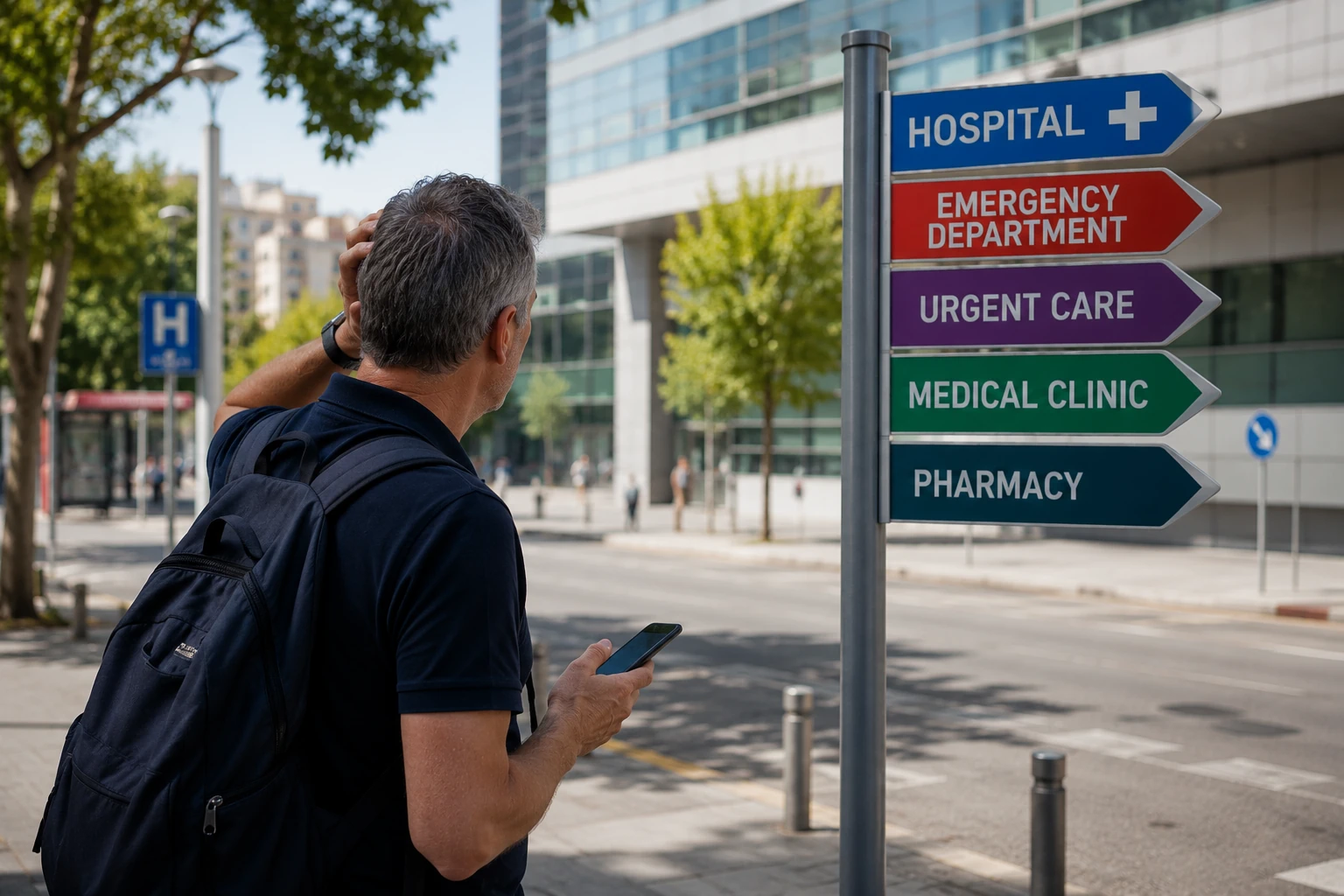
One of the biggest surprises for international travellers is discovering that healthcare works differently almost everywhere.
Some countries rely heavily on public hospitals.
Others have extensive private healthcare networks.
Some destinations have excellent urgent care clinics.
Elsewhere, local doctors may visit your hotel or accommodation.
Even something as simple as making an appointment can be completely different from what you’re used to at home.
This uncertainty often creates more anxiety than the illness itself.
Imagine arriving at a hospital only to discover that a nearby clinic would have been faster and more appropriate.
Or spending hours searching online for an English-speaking doctor while feeling increasingly unwell.
Knowing where to start can make the entire experience much less stressful.
When Should You Call Emergency Services Immediately?
Some situations should never be delayed.
Seek immediate emergency assistance if someone experiences:
- Difficulty breathing
- Severe chest pain
- Loss of consciousness
- Heavy bleeding
- Serious head injuries
- Stroke symptoms
- Major trauma following an accident
These situations require immediate professional evaluation.
Don’t spend valuable time trying to diagnose the problem yourself.
Your role isn’t to determine what’s wrong.
Your role is to make sure the person receives professional medical attention as quickly as possible.
One Challenge Travellers Rarely Think About
Imagine trying to explain this sentence in a language you don’t speak.
“I’ve had severe abdominal pain for six hours. It gets worse every time I stand up.”
Now imagine trying to explain:
- your allergies,
- medications,
- medical history,
- or symptoms.
Language barriers create uncertainty at exactly the moment when clear communication becomes most important.
This is one reason many travellers feel far more vulnerable abroad than they would at home.
Being able to communicate your symptoms clearly helps healthcare professionals understand your condition more quickly and allows you to make informed decisions about your care.
Finding Medical Help Abroad Isn’t Always as Simple as It Sounds

When you’re at home, finding a doctor is usually straightforward.
You know which clinic you trust.
You know where the nearest hospital is.
You probably even know someone who can recommend a specialist.
Travel changes all of that.
Now imagine you’re in Barcelona.
It’s 9:30 PM.
Your hotel receptionist has already gone home.
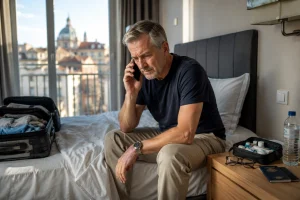
You have a fever that keeps climbing, and you’ve started feeling dizzy.
You open your phone and search:
doctor near me
Within seconds, you’re looking at hundreds of search results.
Private clinics.
Medical centres.
Urgent care facilities.
Hospitals.
Reviews in a language you don’t understand.
Different opening hours.
Different healthcare systems.
How do you know which one is right?
The truth is, most travellers don’t.
And they shouldn’t be expected to.
Finding medical help abroad isn’t simply about locating the closest clinic.
It’s about finding the right medical help for your situation.
Sometimes that’s a doctor’s consultation.
Sometimes it’s an urgent care clinic.
Sometimes it’s immediate hospital treatment.
Knowing the difference can save both valuable time and unnecessary stress.
Expert Insight
One of the biggest challenges travellers face isn’t finding healthcare.
It’s understanding where they should go first.
Why Medical Coordination Matters
When people hear the phrase medical assistance, many assume it means someone is replacing the local healthcare system.
That’s not how it works.
Think of medical coordination as having someone who helps you navigate unfamiliar healthcare when you’re far from home.
Instead of trying to make important decisions while you’re feeling unwell, medical coordination helps you understand your options and guides you toward appropriate medical care.
That support may include helping you:
- Understand your next steps.
- Connect with licensed doctors.
- Arrange a doctor visit to your accommodation where available.
- Navigate unfamiliar healthcare systems.
- Access medical assistance more confidently.
You still receive care from qualified healthcare professionals.
The difference is that you don’t have to figure everything out on your own.
For many travellers, that’s exactly what turns a stressful situation into a manageable one.
Learn more about how our medical coordination process works
Sometimes, the Best Place to See a Doctor Isn’t a Hospital
One of the biggest misconceptions travellers have is believing every illness requires a hospital visit.
In reality, hospitals are designed to prioritise serious and life-threatening emergencies.
For many non-life-threatening situations, another option may be more appropriate.
Depending on your destination and the medical situation, a licensed doctor may be able to visit your:
- hotel
- resort
- Airbnb
- holiday apartment
Imagine waking up with a high fever after arriving in Paris.
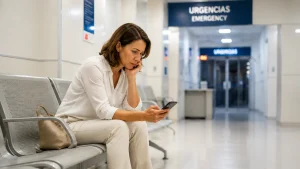
The last thing you want is to navigate public transport while feeling exhausted or spend hours waiting in an unfamiliar emergency department.
Receiving professional medical attention at your accommodation can often make the experience far less stressful.
More importantly, a doctor can assess your condition and determine whether additional medical care is necessary.
The Mistakes Travellers Make Most Often
Medical emergencies are stressful by nature.
But many difficult situations become even more complicated because travellers make decisions based on uncertainty rather than information.
Here are the most common mistakes.
Waiting too long
Many people convince themselves they’ll feel better after some rest.
Sometimes they do.
Sometimes they wake up feeling considerably worse.
When symptoms continue to develop, seeking professional medical advice early is almost always the better decision.
Searching the internet instead of speaking to a doctor
The internet can explain symptoms.
It cannot evaluate your symptoms.
Reading dozens of possible diagnoses often creates more anxiety than clarity.
Professional medical guidance is always more valuable than online speculation.
Underestimating dehydration
Travellers often associate dehydration with extremely hot destinations.
In reality, vomiting, diarrhoea, long flights and even sightseeing all day without drinking enough water can quickly lead to dehydration.
Early medical advice helps prevent more serious complications.
Forgetting important medical information
Trying to remember medication names while feeling unwell isn’t easy.
Before travelling, keep a digital record of:
- medications
- allergies
- pre-existing conditions
- emergency contacts
It only takes a few minutes to prepare—and it can make a significant difference if you ever need medical attention abroad.
Before You Travel, Take Fifteen Minutes to Prepare
Most people spend weeks organising flights, accommodation and sightseeing.
Almost nobody spends fifteen minutes preparing for a medical situation.
Ironically, those fifteen minutes may become the most valuable part of your travel planning.
Before your next trip, ask yourself:
- Do I know the local emergency number?
- Do I have my medications organised?
- Could someone contact my family if necessary?
- Do I know how I would access medical help in another country?
One simple way to stay better prepared is to set a travel reminder before you leave. A pre-trip reminder can help you review important medical information, emergency contacts, medications and other travel essentials before your departure.
Preparation doesn’t make you pessimistic.
It makes you confident.
Travel Tip
Save your accommodation address, emergency contacts and important medical information in your phone before you leave home—not after something goes wrong.
Confidence Comes From Knowing You’re Prepared
Nobody books a holiday expecting to become ill.
Medical emergencies are unpredictable.
Preparation doesn’t prevent them.
It simply changes how you’ll respond if they happen.
Knowing where to seek medical help.
Understanding when to call emergency services.
Keeping your medical information accessible.
Having access to professional medical coordination.
These small decisions, made before your trip begins, can make an enormous difference when the unexpected happens.
How Travel Medical Assist Helps Travellers Abroad
At Travel Medical Assist, we understand that getting medical help abroad isn’t just about finding a doctor.
It’s about reducing uncertainty during moments when travellers need clear guidance the most.
Our Digital Travel Medical Assistance Plans are designed to help travellers access professional medical support and medical coordination while they’re away from home.
Depending on the situation and destination, travellers may receive assistance with:
- Access to licensed doctors.
- Medical coordination.
- Doctor visits to hotels or private accommodation where available.
- 24/7 emergency medical support.
- Support for travellers with pre-existing medical conditions.
- Guidance throughout the medical assistance process.
Our goal is simple:
To help travellers feel more confident navigating unexpected medical situations abroad—not by replacing local healthcare, but by helping them access it more effectively.
Explore our Travel Medical Assistance Plans
Travel With Confidence
No traveller wants to imagine a medical emergency interrupting their trip.
Yet the reality is simple:
Unexpected situations happen every day.
The difference isn’t always the emergency itself.
It’s how prepared you are before it happens.
Knowing what to do.
Knowing where to turn.
Knowing you’re not trying to navigate an unfamiliar healthcare system entirely on your own.
That’s what preparation really gives you.
Not certainty.
Confidence.
And sometimes, confidence is exactly what travellers need most when they’re thousands of miles from home.
Frequently Asked Questions
-
What should I do first during a medical emergency abroad?
Stay calm, assess the situation and contact local emergency services immediately if the condition appears life-threatening. For non-life-threatening situations, seek professional medical advice as early as possible.
-
Is every illness abroad considered a medical emergency?
No. Many medical conditions can initially be assessed by a licensed doctor, who can recommend the most appropriate next step based on your symptoms.
-
What information should I keep with me while travelling?
Carry your passport, emergency contacts, current medications, allergy information and details of any pre-existing medical conditions.
-
Can I receive medical assistance at my hotel?
Depending on your location and the nature of your medical situation, a doctor visit to your accommodation may be available.
-
Why should I prepare before travelling?
Preparation helps you respond with confidence if something unexpected happens. Knowing how to access medical assistance before your trip can reduce stress and help you make informed decisions when you need medical support abroad.